
Agriculture Land Value Trends


On the Ground
California agriculture enters 2026 in a market defined less by broad decline and more by increasing selectivity. Across much of the state, agricultural land values are being shaped by a widening divide between water-secure properties and those facing greater groundwater uncertainty, while commodity stabilization in several key sectors offers cautious optimism after years of margin compression. Elevated production costs, tighter lending environments, and SGMA implementation continue to pressure growers, but stronger long-term fundamentals are beginning to emerge in certain permanent crop sectors, particularly where reliable water and operational efficiency remain intact.
While commodity performance still plays an important role, agricultural land values are increasingly being driven by water security, financial durability, and long-term adaptability. In 2025, California’s agricultural real estate market demonstrated that dependable surface water access, irrigation district reliability, and sustainable operational models often carried greater weight than commodity prices alone. Properties located in established water districts generally maintained stronger demand and pricing, while groundwater-reliant acreage in constrained basins faced continued downward pressure.
Permanent crops such as almonds, pistachios, and walnuts continued their multi-year recalibration, with orchard removals remaining elevated in weaker districts but stronger, water-secure assets showing signs of stabilization. Row crop ground in premium production areas remained relatively stable, while wine grape markets continued to experience significant headwinds due to oversupply and shifting consumer demand. Across nearly every commodity class, buyers and operators have become more disciplined, prioritizing long-term viability over speculative expansion.
Despite evolving challenges, California agriculture continues to offer meaningful opportunities for growers, investors, and landowners who understand regional dynamics. Strategic acquisitions, operational repositioning, family succession planning, and water-secure investments all remain viable pathways in a market that increasingly rewards informed decision-making.
Farmland ownership and agricultural production remain central to California’s economy, communities, and legacy. Whether evaluating a producing orchard, open cropland, dairy operation, or long-term development opportunity, understanding the intersection of commodity trends, water policy, and land economics has never been more essential.
As market conditions continue to evolve, working with professionals who understand both the operational realities of agriculture and the complexities of land valuation is critical. Terra West Group remains committed to helping landowners, growers, and agribusinesses navigate changing market conditions, identify strategic opportunities, and make sound real estate decisions with confidence.
Land value information is derived from Terra West Group’s proprietary transaction database, in conjunction with the annual Trends® in Agricultural Land and Lease Values report from the California Chapter of ASFMRA, shared with permission. The full report is available at www.calasfmra.com.



North San Joaquin Valley
(San Joaquin, Stanislaus & Merced Counties)


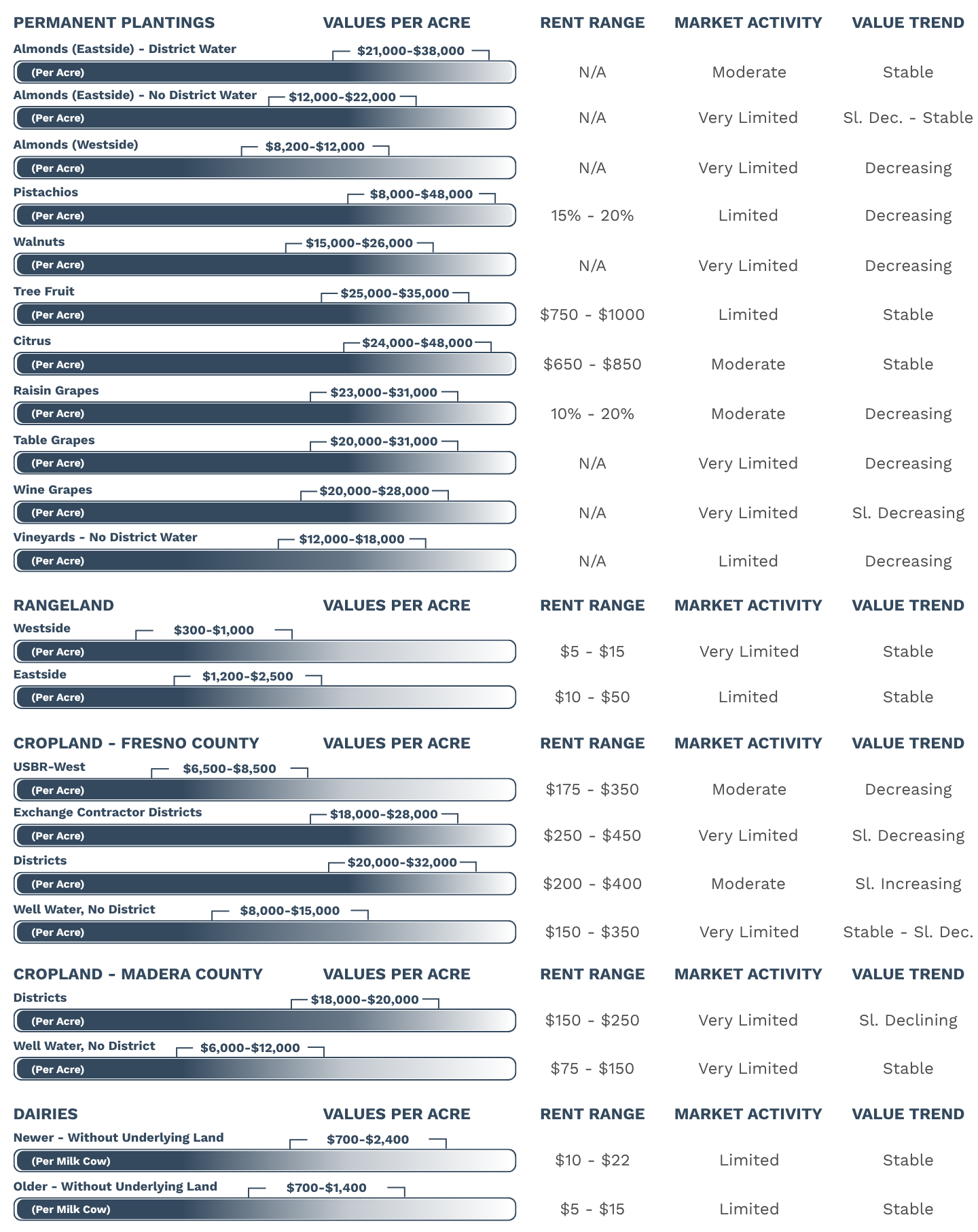
Central San Joaquin Valley
(Fresno & Madera Counties)

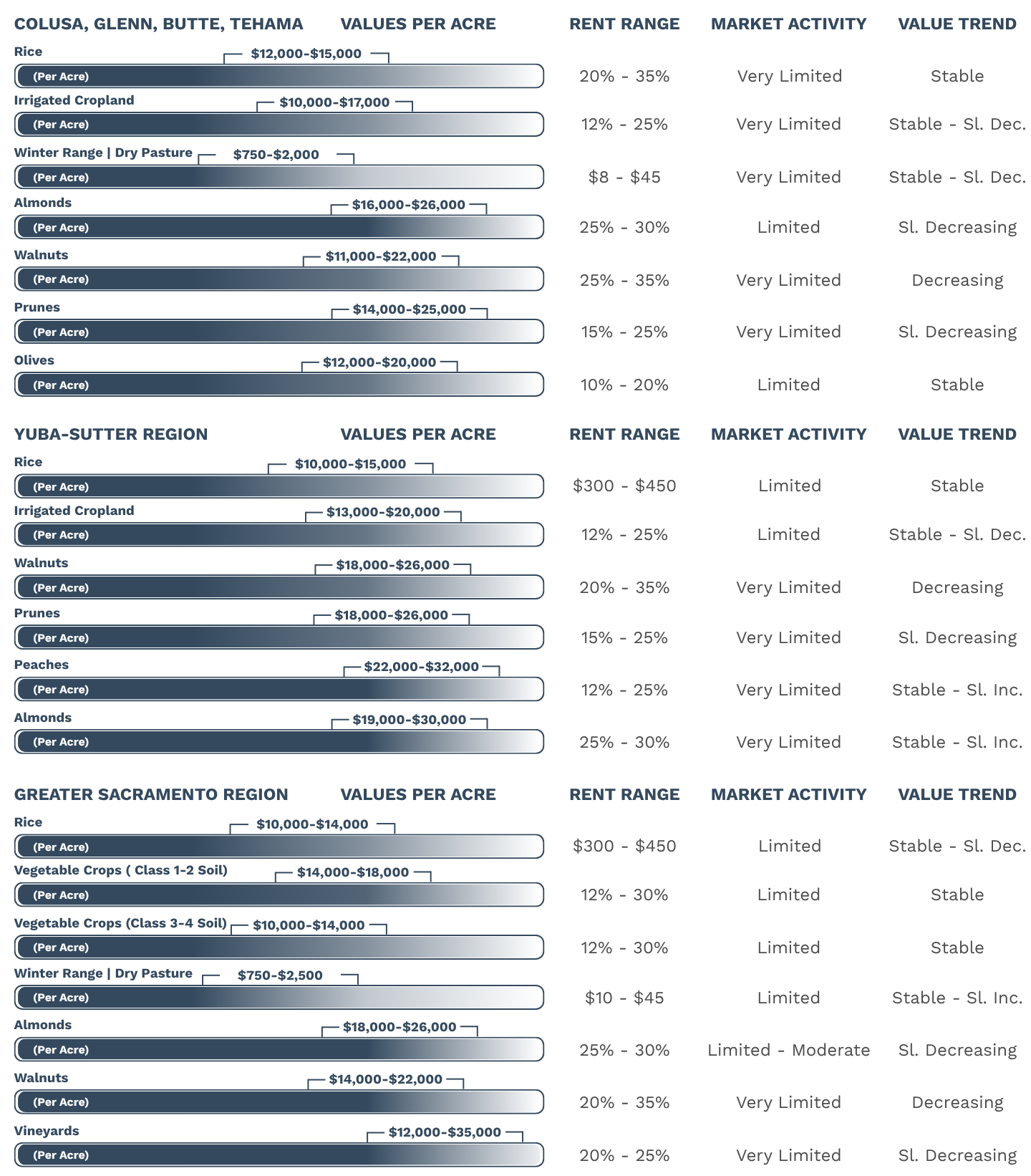
Sacramento Valley
(Butte, Colusa, Glenn, Solano, Sutter, Yuba & Yolo Counties)

South San Joaquin Valley
(Kern, Tulare & Kings Counties)


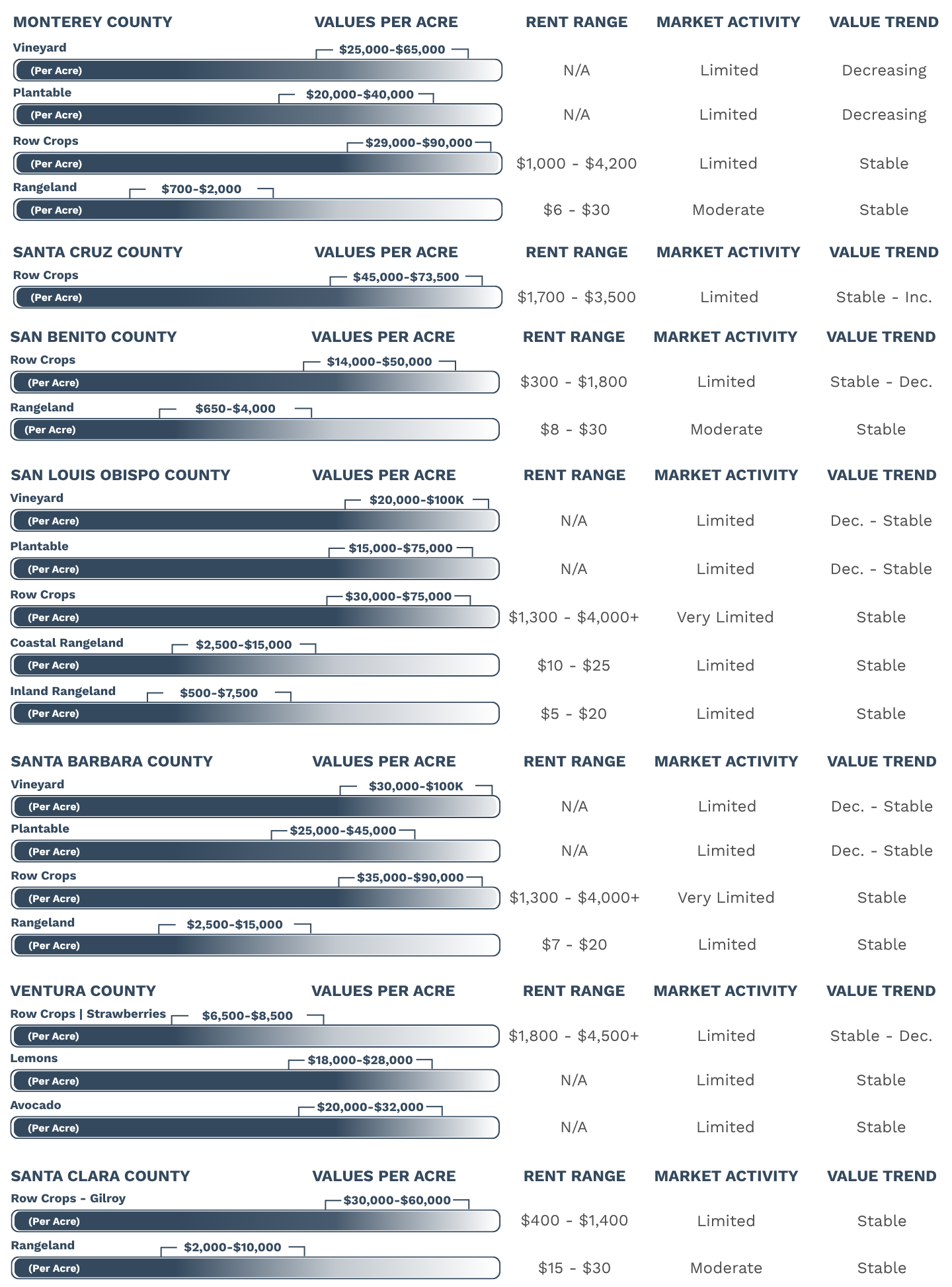
Central Coast
(Monterey, Santa Cruz, San Benito, San Louis Obispo & Santa Barbara)

North Coast
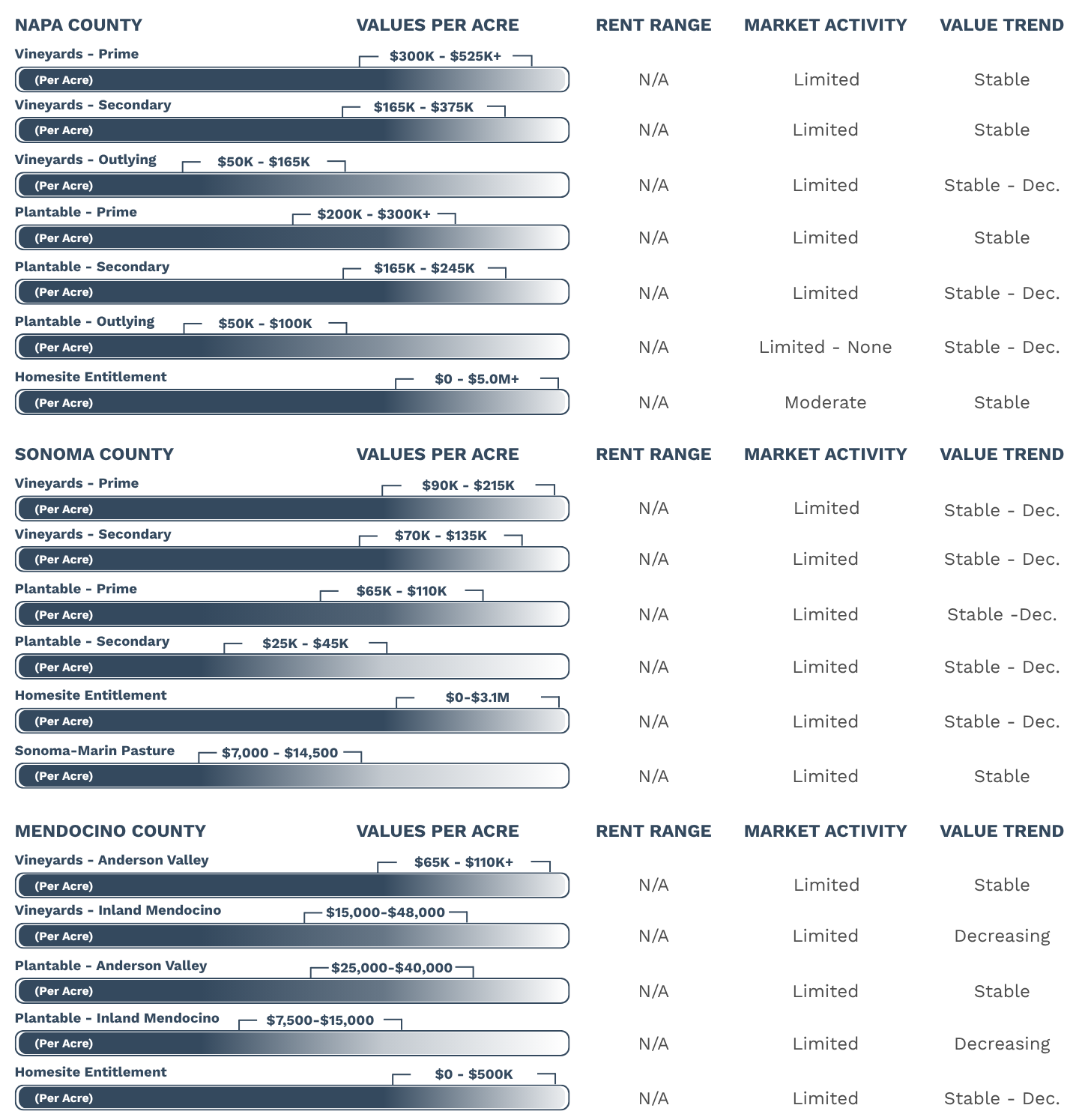
(Napa, Sonoma and Mendocino Counties)